World Mental Health Day is upon us again, and we’re facing a crisis of flourishing among today’s young people. According to the WHO, 1 in 7 children aged 10-19 faces poor mental health every year. This affects their everyday choices, their relationships, their learning, and even their sense of hope for the future.
But we don’t have to wait for more children to suffer before we do something about it. Because at Brio we estimate there’s a global workforce of 50 million teachers in public schools, who have committed their daily lives to helping children learn and grow.
Today, we’re naming how much this matters, and the potential it represents. Teachers are not just the “heroes” we thank on the way to better and brighter child outcomes; they are the way.
Teacher mental health is under-supported and under-leveraged
There’s now plenty of research about the power of having a caring adult in a child’s life to improve their overall life outcomes, including their mental health.
Imagine spending a whole day in school, 6 days a week, with someone who’s supposed to help you find your curiosity, strengthen your cognitive skills, and be excited to try again after failing. But, instead of showing up with energy and compassion, that person is overloaded, impatient, or burned out.
This is the reality too many children face, but it doesn’t have to be. When teachers experience positive mental health for themselves, they’re able to model and embody it in the classroom everyday. It’s not just about implementing a social-emotional learning curriculum; it’s about how they respond to children’s questions, behaviors, fears, hopes, and needs for connection.
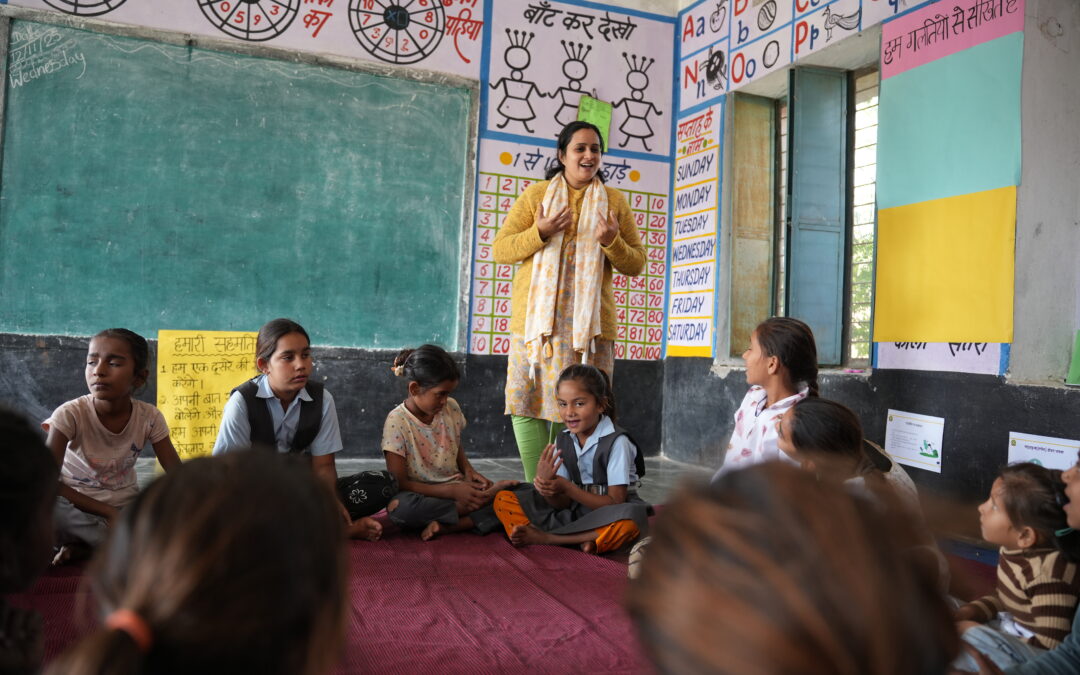
Since 2018, we’ve worked with teachers across the world who are responsible for whether children in marginalized communities learn what they need to. All too often, these teachers have little institutional support.
And we’ve addressed that by creating simple, scalable programs for teachers to experience wellbeing for themselves, and to cultivate those skills for the classroom.
Here’s what happens when teachers’ mental health improves.
1) They become more calm and committed, even in the midst of a stressful job.
Teaching is frontline work, especially in communities affected by poverty, injustice or violence. In Rajasthan where we work, 70% of children attend government schools, and many schools are staffed by just a few teachers.
A teacher’s ability to navigate their own internal world— thoughts, feelings, emotions, worries, pressures— can make or break their presence in the classroom. Mental health skills allow them to hold their own experience with more stability and compassion. It allows them to reconnect to the personal values or sense of purpose that brought them into the classroom.
Through this program, we were able to become conscious of our mental wellbeing. We learned well how to keep ourselves balanced and at ease amidst ever-changing circumstances. We’re also sharing these lessons with our colleagues and students. – Kiran Choudhary, Jhalawar, Rajasthan
2) They create more kind and compassionate classrooms, especially helping students who are struggling.
A teacher’s pedagogical knowledge can increase dramatically, and they can implement a mindfulness activity by reading a script. But here’s a tough truth that we’ve observed: if they are emotionally dysregulated, using traditional fear-based tactics, or otherwise disengaged from their students the rest of the day, none of it matters.
Teachers who cultivate personal mental health skills are able to offer presence, compassion, and courage throughout the day. This shifts their classroom environment by changing their demeanor. And the children who benefit most are those who are struggling and those who are marginalized.
In our school, children previously hesitated to come due to fear and stress. After connecting with Khushi Shala, we permanently removed the fear from the classroom, replacing it with open dialogue, warmth, and respect. Today, when the morning bell rings, children run towards the school smiling and laughing. – Vijay Prakash Jain, Banswara, Rajasthan
I would frequently react without properly understanding my students’ academic difficulties and would repeatedly complain about them to their parents. Now, before reacting, I try to connect with my students and empathetically understand the reasons behind their behavior. Because of this, the students now feel more connected to me, they share even their small concerns with me, and the classroom environment has become much more joyful and cheerful. – Primary grade teacher, Delhi
3) They help children practice the same skills, both inside and outside the classroom.
We often say that children don’t learn from a curriculum on a page; they learn from the adult in the room, their teacher. When teachers experience the benefits of positive mental health, it changes their behavior in the classroom. Furthermore, they are intrinsically motivated to help their students learn the same skills. And that’s when they’re ready to implement new classroom activities and stories that enable children to experience these skills for themselves.
We’ve seen it happen where teachers take the state curriculum and make it their own, inspired by their own wellbeing journey. This is where the magic happens. It’s not primarily program “fidelity” or “perfect implementation” that drives impact; we think it’s teachers who have experienced a sense of wholeness and connection.
After these Khushi Shala classes, a sense of confidence has emerged. Everything, in some way, is connected to sensitivity, and now they express what they like or dislike. Children also make paintings, and such activities help connect with them better. Earlier, even saying ten lines about themselves felt challenging. After Khushi Shala, not only am I able to express myself better, but the children are also becoming more expressive. Their shyness has reduced significantly. – Head of Institution, Pindwara, Rajasthan
I spoke to a student about showing compassion toward living beings and suggested he release a tortoise he had kept. He not only understood the message but even made a video and shared it with me later. That moment really touched me. – Yasvendra Sir, Karauli, Rajasthan
Let’s support teachers, the people shaping children’s lives everyday.
The crisis of children’s mental health is a crisis for our shared humanity. It’s not just about a lack of the right mental health resources or professionals, as important as they are. And it won’t be solved by technology, better programming, or policy alone.
The deep and often slower work of behavior change from the inside out— first for teachers, then for children— is the transformative pathway we need.
When we celebrate and support teachers, we’re not just seeing them for the value that they bring to the world’s children— our children. We’re recognizing their power to create powerful experiences within their classrooms that show children that the world is worth knowing, worth exploring, worth caring about.