Our evidence-based framework
Download guideAcceptance & Commitment Training for children’s and teachers’ wellbeing
All our programs are rooted in Acceptance and Commitment Training (ACT) – one of the most research-backed mental health frameworks out there, with over 1,000 randomized controlled trials supporting its ability to build psychological flexibility. The approach helps alleviate mental illness, prevent its onset, and promote positive mental health.
The power of ACT
1,000+
supporting studies across a wide range of populations
94%
randomized-controlled trials were completed within the last decade
20
meta-analyses demonstrating ACT is efficacious
The main goal of ACT: psychological flexibility
Psychological flexibility consists of 6 key mental skills—mindfulness and action skills—that help us stay engaged in building a rich, meaningful and purposeful life even in the midst of ongoing challenges.
Mindfulness Skills
The mindfulness skills are about fully entering the present moment as the only place and time where choice and action are possible.
Be Present
Being present means making full contact with the present moment, including all aspects of your body, thoughts, and emotions. By learning to keep our attention focused in the present, worry, anxiety, negative thoughts, and dire predictions hold less power. We discover that there is more choice, more freedom, and more flexibility in the present moment than the past or future can ever offer us.
Acceptance
Acceptance means making space for the wholeness of our experience—even the unpleasant parts. It means learning how to acknowledge our experience as a normal part of what it means to be human. When we learn how to open up to our full experience, it frees us up to drop the struggle with ourselves and to start turning our energies to the things that matter most to us.
Defusion
When we are experiencing difficult emotions, our thoughts are often also a significant piece of the suffering. Oftentimes, they get so frequent and so strong that it is as if they sink their hooks into us and simply won’t let go. One way we can practice disentangling ourselves is to bring the same observation and curiosity to our thoughts that we bring to other parts of our experience. This can give us a little space to step back rather than getting caught up in our thoughts and feelings.
Self-as-Context
We all hold self-stories: labels, descriptions, and even factual statements about ourselves that help us to make sense of who we are. Sometimes, they can be invaluable. Other times, we may cling so tightly to one piece of identity content that it costs us something important. But what if we learned how to distance our sense of self from the content or our self-stories, as if we are observing all those ideas swimming around inside of us? This is what Self-as-Context is all about.
Action Skills
The action skills are key to making the choices and taking the action that leads to a meaningful life. But action alone is not enough without being guided by clear values—knowing what really matters in life.
Values
Values are more than goals and temporary feelings. They describe the essence of our way of being in the world: our chosen qualities; what is truly important to us about being a friend, a family member, a partner, a co-worker, or simply a human being. Articulating our values clearly, even if our goals take longer to reach or the feelings aren’t always easy, allows us to stay committed to becoming the very best version of ourselves that we can be.
Committed Action
Despite the popular idea of using incentives and punishments, the most effective way to create long-term change is to root our efforts in our core values. This is why this skill is called “Committed Action”— making a commitment to living in alignment with our core values. When we root our actions in our values, they provide guidance for our direction and ideas about what concrete steps we can take, so that we can continue to commit ourselves to what is truly important.
The main goal of ACT: psychological flexibility
Psychological flexibility consists of 6 key mental skills—mindfulness and action skills—that help us stay engaged in building a rich, meaningful and purposeful life even in the midst of ongoing challenges.
Mindfulness Skills
The mindfulness skills are about fully entering the present moment as the only place and time where choice and action are possible.
Be present
Being present means making full contact with the present moment, including all aspects of your body, thoughts, and emotions. By learning to keep our attention focused in the present, worry, anxiety, negative thoughts, and dire predictions hold less power. We discover that there is more choice, more freedom, and more flexibility in the present moment than the past or future can ever offer us.
Acceptance
Acceptance means making space for the wholeness of our experience—even the unpleasant parts. It means learning how to acknowledge our experience as a normal part of what it means to be human. When we learn how to open up to our full experience, it frees us up to drop the struggle with ourselves and to start turning our energies to the things that matter most to us.
Defusion
When we are experiencing difficult emotions, our thoughts are often also a significant piece of the suffering. Oftentimes, they get so frequent and so strong that it is as if they sink their hooks into us and simply won’t let go. One way we can practice disentangling ourselves is to bring the same observation and curiosity to our thoughts that we bring to other parts of our experience. This can give us a little space to step back rather than getting caught up in our thoughts and feelings.
Self-as-Context
We all hold self-stories: labels, descriptions, and even factual statements about ourselves that help us to make sense of who we are. Sometimes, they can be invaluable. Other times, we may cling so tightly to one piece of identity content that it costs us something important. But what if we learned how to distance our sense of self from the content or our self-stories, as if we are observing all those ideas swimming around inside of us? This is what Self-as-Context is all about.
Action Skills
The action skills are key to making the choices and taking the action that leads to a meaningful life. But action alone is not enough without being guided by clear values—knowing what really matters in life.
Values
Values are more than goals and temporary feelings. They describe the essence of our way of being in the world: our chosen qualities; what is truly important to us about being a friend, a family member, a partner, a co-worker, or simply a human being. Articulating our values clearly, even if our goals take longer to reach or the feelings aren’t always easy, allows us to stay committed to becoming the very best version of ourselves that we can be.
Committed Action
Despite the popular idea of using incentives and punishments, the most effective way to create long-term change is to root our efforts in our core values. This is why this skill is called “Committed Action”— making a commitment to living in alignment with our core values. When we root our actions in our values, they provide guidance for our direction and ideas about what concrete steps we can take, so that we can continue to commit ourselves to what is truly important.
ACT at the community level
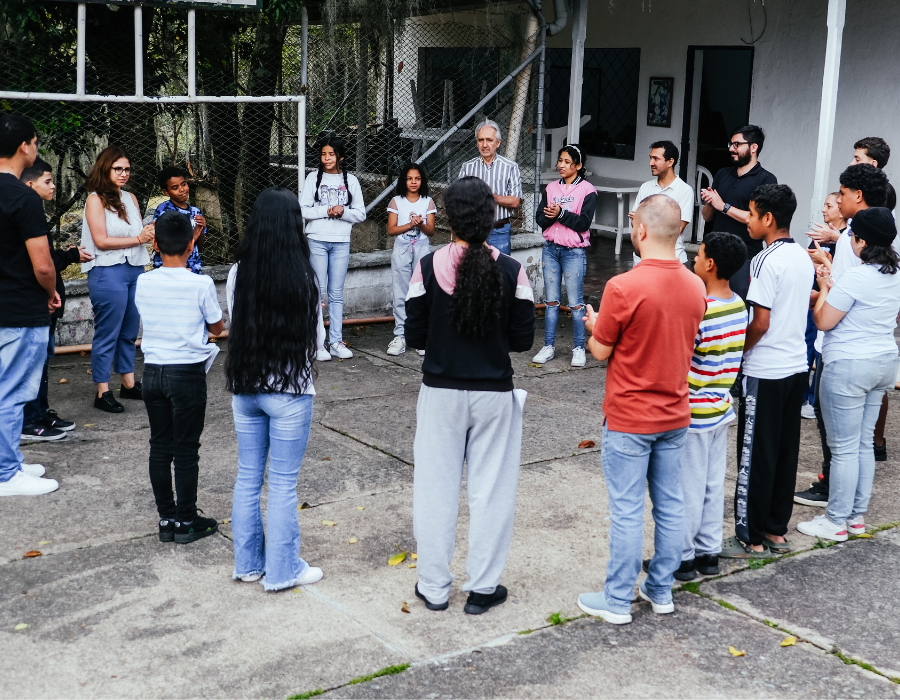
ACT helps not only those with mental health conditions, but everyone to experience greater freedom and agency to live meaningfully.
Plus, it can be cultivated across various contexts using very few resources—no equipment, pharmaceuticals, or years of education required.
That’s why it’s a highly effective way to promote mental health at the community and population level.

What about marginalized contexts?
ACT is a particularly relevant framework for individuals and communities experiencing adversity.
At its core, the method helps us change the way we relate to our pain by turning toward our experiences with openness, even kindness.
This expands our range of choices, allowing us to live out our personal and communal values through concrete action.
How does it work in practice?
Through relevant stories and activities, we explore what it looks like to live “the good life”—a life of meaning, connection and purpose, even if external circumstances continue to be difficult.
Intro to ACT in 3 steps
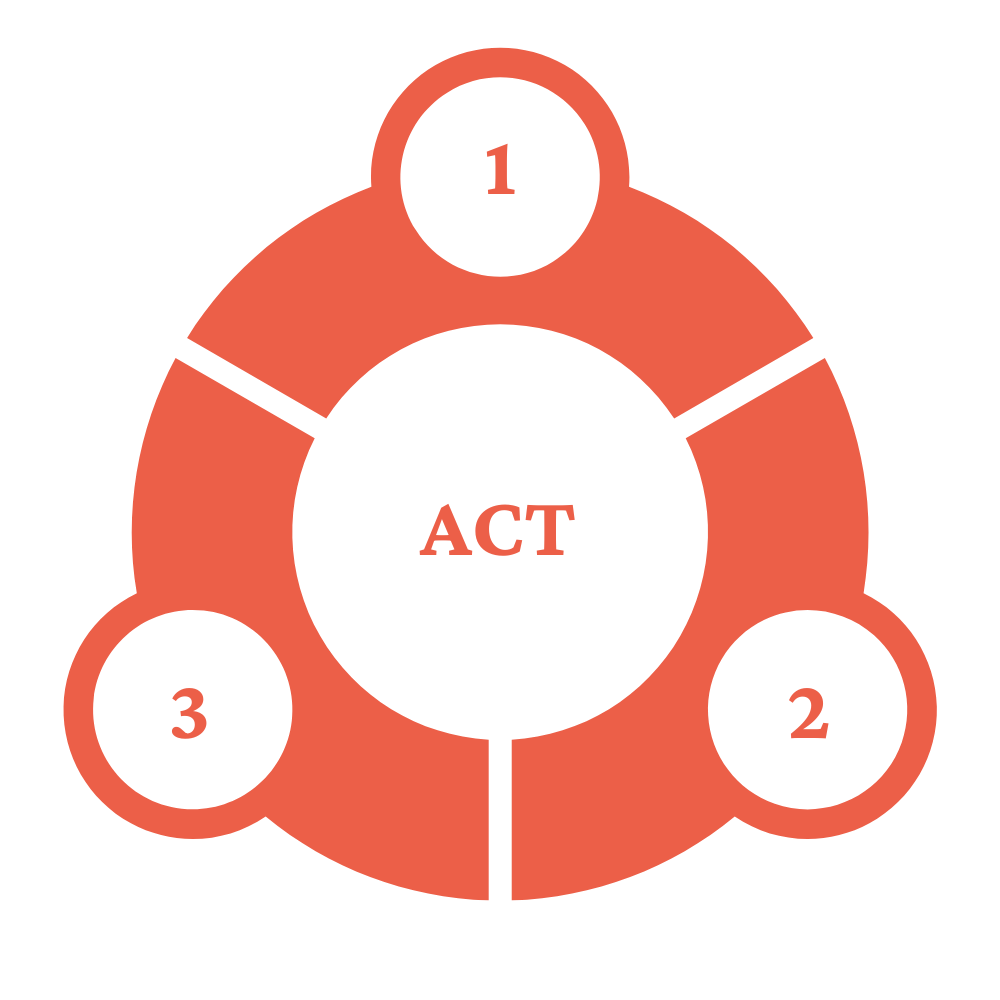
We cluster the ACT skills into three easy-to-learn concepts: Be present. Have compassion. Do what matters.

Culturally adapted stories
We co-create culturally adapted stories and metaphors to illustrate the ACT skills in ways that resonate and stay with participants.

Diverse delivery channels
We use delivery channels such as in-person groups, radio, creative activities, virtual check-ins, WhatsApp, and curriculum, tailored to local context needs.
Psychological flexibility in action
Discover how teachers and children are cultivating positive mental health by using ACT.

Khushi Shala – flourishing classrooms
In Rajasthan’s public schools
For school-aged children, the ACT principles and skills are taught through stories and activities that relate to their everyday lives. Teachers are offered easy classroom practices and lessons to utilize throughout the school day, creating moments of experiential learning and reflection. Children move from awareness to expression to identifying and doing what is important to them.

Hausla – wellbeing skills for teachers
In Rajasthan, Delhi, and Bihar
Teachers are frequently carrying numerous responsibilities— demands that go far beyond just teaching. ACT skills help them to stay rooted in their chosen values so that they can show up with consistency and kindness in their classrooms. Many teachers have found these trainings to be personally useful, not just in the context of school but at home as well.
Learn more about ACT