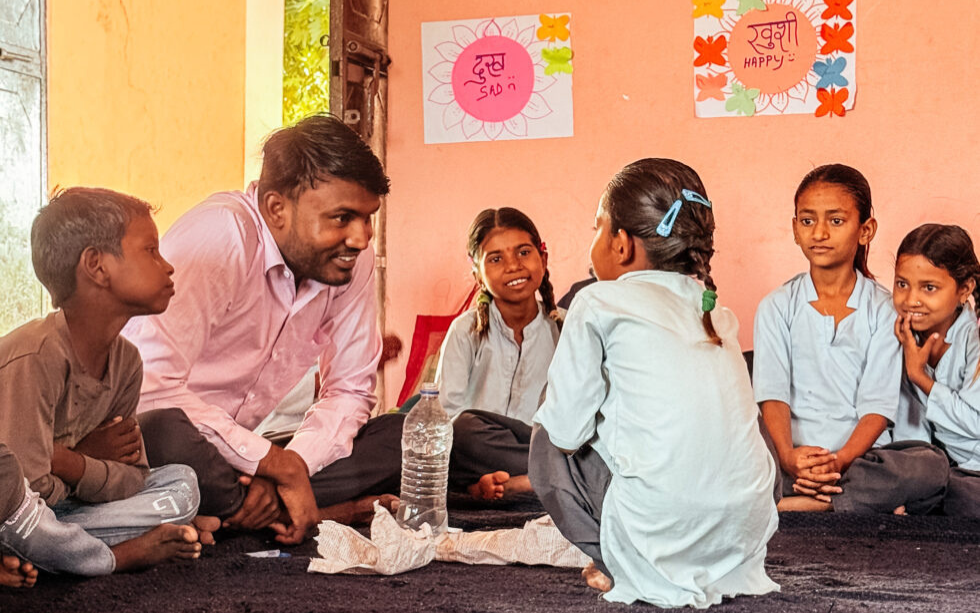
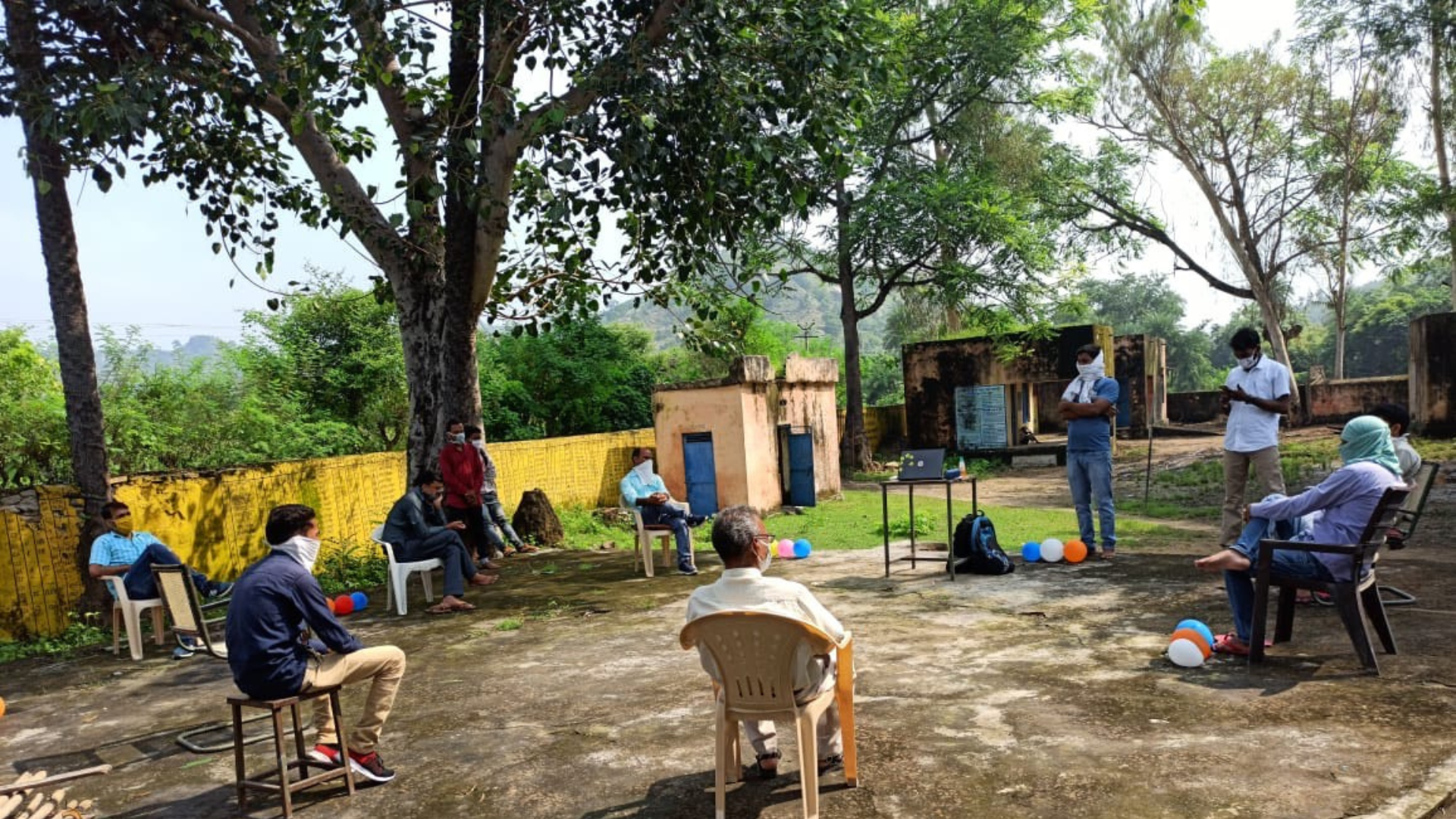
At the height of the Covid-19 pandemic, a group of government school teachers in rural Rajasthan began gathering around a small speaker to listen to audio lessons about their own inner lives. Schools were closed and uncertainty was everywhere. And yet, at the initiative of our partners at Kshamtalaya Foundation, we had designed something that could travel by audio, require little internet connection, and be shared with a friend, a neighbor, a colleague. It was called Hausla— courage, in Hindi.
What happened next shaped everything that followed. Teachers reported reduced stress and a renewed sense of purpose, even as they were temporarily converted to community healthcare workers as a way to reach rural villages with critical pandemic information.
When they did start returning to school, they described their classrooms changing in culture. Hausla spread organically, and eventually was adopted by the state of Bihar in 2023. Since then, it has reached more than 130,000 educators across India. But it was the things teachers said that stayed with us most.
“There is a taboo around mental health. But this program made me realize that it is very normal and everyone goes through difficulties. How you treat us — this will hopefully now reflect in my classroom and my family as well.“
“In our current times it is very difficult to bring coherence between our personal and professional lives… This program has helped me to find a solution, enjoy the simplicity of life and find peace.”
Here’s what we learned from them: when teachers felt genuinely supported, as human beings first with education as their vocational calling, it unlocked a sense of stability and purpose. Over time, this insight has expanded how we think about our own quest in strengthening mental health at the community and population level, and now we’re ready to take the next step.
Our founding vision of community-driven mental health
In 2018, Brio was founded on the belief that mental health is not a luxury, and not only a clinical problem. It is a human capacity for agency and liberation— something that can be strengthened, practiced, and shared— and it belongs to everyone, regardless of circumstance.
For the first several years of our work, we partnered with community-rooted organizations supporting a wide range of people navigating extraordinary hardship: human rights defenders, women refugees, indigenous youth, adolescent girls in communities shaped by violence and poverty. In each context, we brought an evidence-based framework— Acceptance and Commitment Training, or ACT— that could adapt to the values and circumstances of each community, and we worked to design programs with local organizations whose relationships ran far deeper than ours ever could.
That work taught us a great deal about program co-creation, about humility, and about what it actually means to show up alongside a community rather than arrive with a predetermined solution. It also clarified something critical about improving mental health proactively: the deepest and most lasting change tends to happen when mental health skills are embedded in the everyday environments where people already live, learn, and grow. And for children, one of the most formative of those environments— recurring, structured, and present across years of development— is the classroom.
Over time, that learning brought greater clarity. One of the most powerful places to shape mental health outcomes is the classroom, where young people form their understanding of themselves and others, encounter difficulty, build relationships, and begin to learn what it means to navigate the world.
Moving forward, this is where Brio has chosen to focus.
Children’s mental health, with and through their teachers
When organizations design mental health programs for children, they often hand teachers a curriculum to deliver— activities, lessons on emotions, or guided exercises— without first helping teachers experience positive mental health for themselves. This gap is significant, not because those curricula are wrong, but because they are incomplete.
The ambition to scale is a pitfall for too many leaders who see teachers as delivery mechanisms for an innovation. But they are not simply “channels”; they are whole human beings who show up each day in front of children who are watching everything: how they respond to frustration, how they handle a child who is struggling, whether they seem present or depleted.
Teacher wellbeing shapes the emotional environment of the classroom, and in doing so, it models in real time what mental health and wellbeing actually look like in practice. Teachers are stewards of the future and custodians of culture in the deepest sense: they shape norms, demonstrate how support is given and received, and influence whether mental health is something children learn to name and build, or something that remains unspoken.
The research reflects the weight of what they carry. A 2026 study of rural government schools in Uttar Pradesh found that 78% of teachers reported burnout, with non-teaching responsibilities identified as the primary driver of stress. In India, more than 120,000 government schools are staffed by a single teacher— educators who are expected to manage classrooms, fulfill administrative requirements, support community functions, and deliver government programs, often in under-resourced conditions and without adequate support for their own wellbeing. This is the reality they bring to the classroom every morning.
If we want children to learn the mental health skills they need to thrive, then supporting teachers’ mental health is not a peripheral concern. It is the prerequisite for everything else.
Why classrooms are the highest-leverage place for change
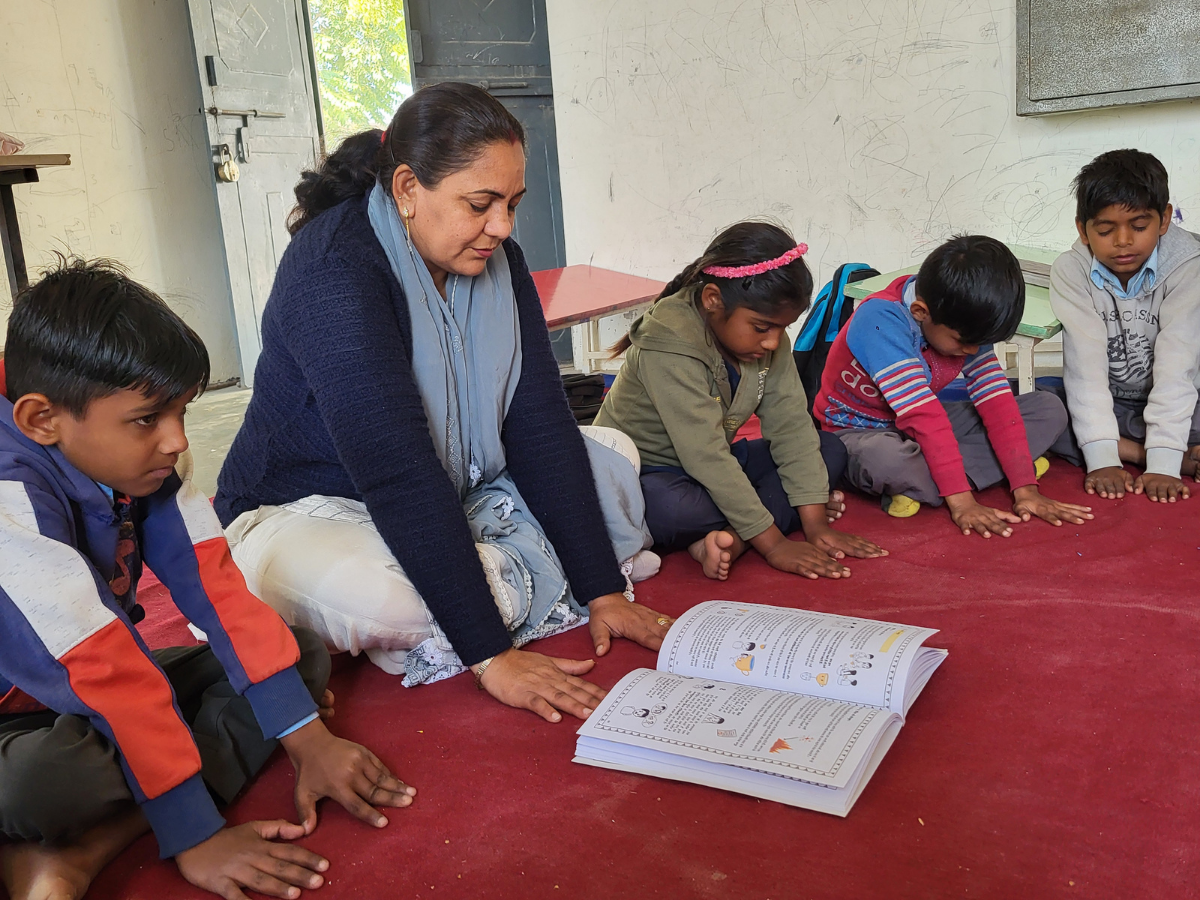
Schools are community infrastructure in a way that few other institutions are. It is, at least in principle, accessible to every child, regardless of their family’s resources, social networks, or proximity to services. It is recurring across years, not weeks: unlike the healthcare system where interaction with a worker can be as short as 2 minutes, a teacher spends a minimum of months if not years with the same child. When mental health skills are embedded in the school day, they are not a one-time intervention; they become part of the rhythm of a child’s development, practiced and reinforced across the years that matter most.
And because children take what they learn home, the reach extends well beyond the classroom. A child who can increase their awareness of feelings and sensations, act from their values under pressure, and hold difficulty without being overwhelmed by it— that child brings those capacities into their family, their community, and eventually their adult life. Schools, in this sense, are one of the strongest pathways to shaping mental health outcomes earlier, more consistently, and more systemically than almost any other channel available.
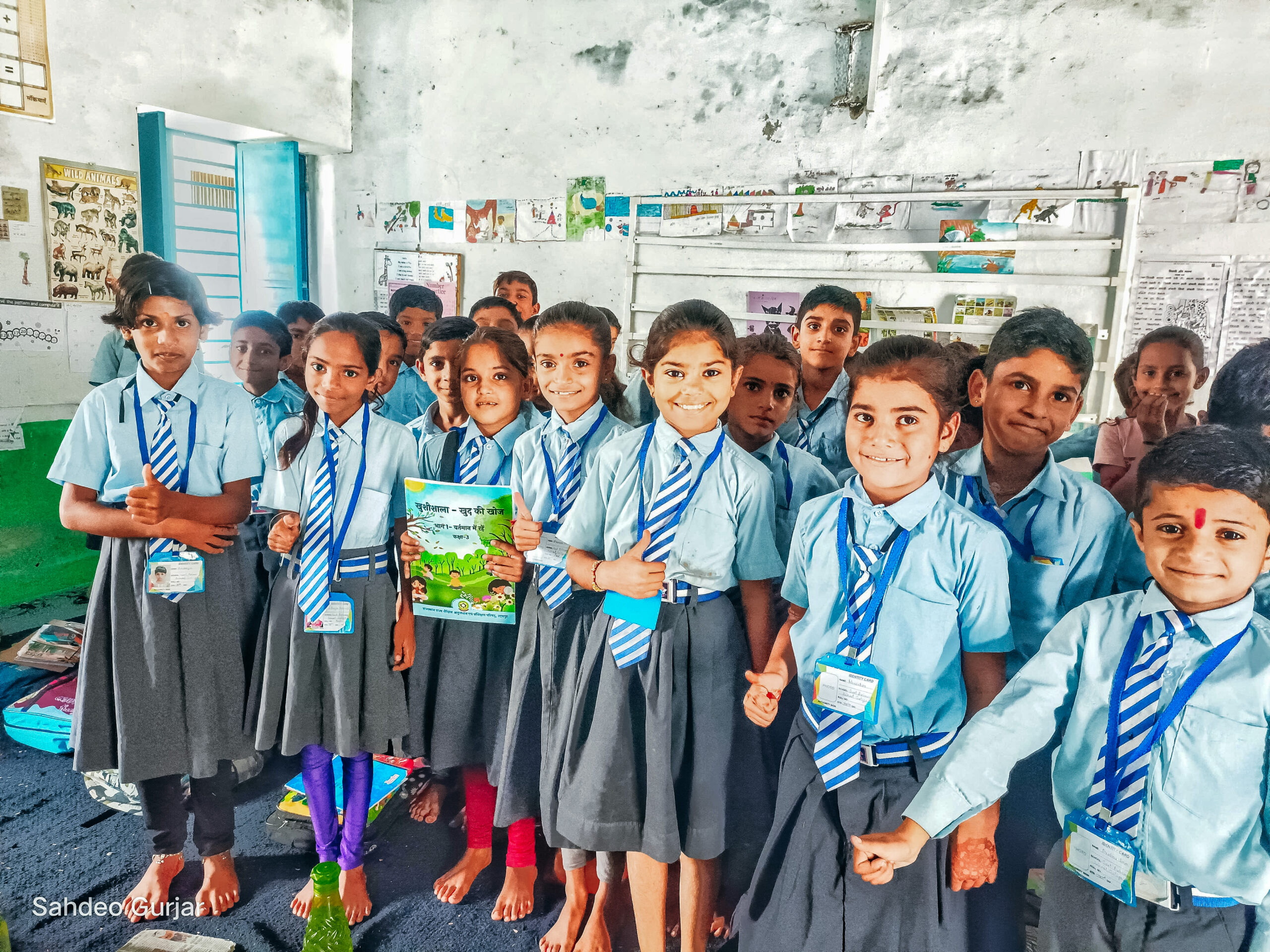
Because schools also operate within systems, improvements can move at a scale that community programs rarely achieve on their own. The state of Rajasthan has chosen to integrate Khushi Shala, the mental health teacher training and activity book co-created by Brio and Kshamtalaya for primary grades, across all of its schools. At full implementation, that means 120,000 teachers and 3.3 million children. This did not happen because we handed something to the government. It happened because, over years of patient co-design with Kshamtalaya, teachers, children, and officials who became genuine champions of the work, the program earned its place within the system.
Sharpened focus, same radical collaboration
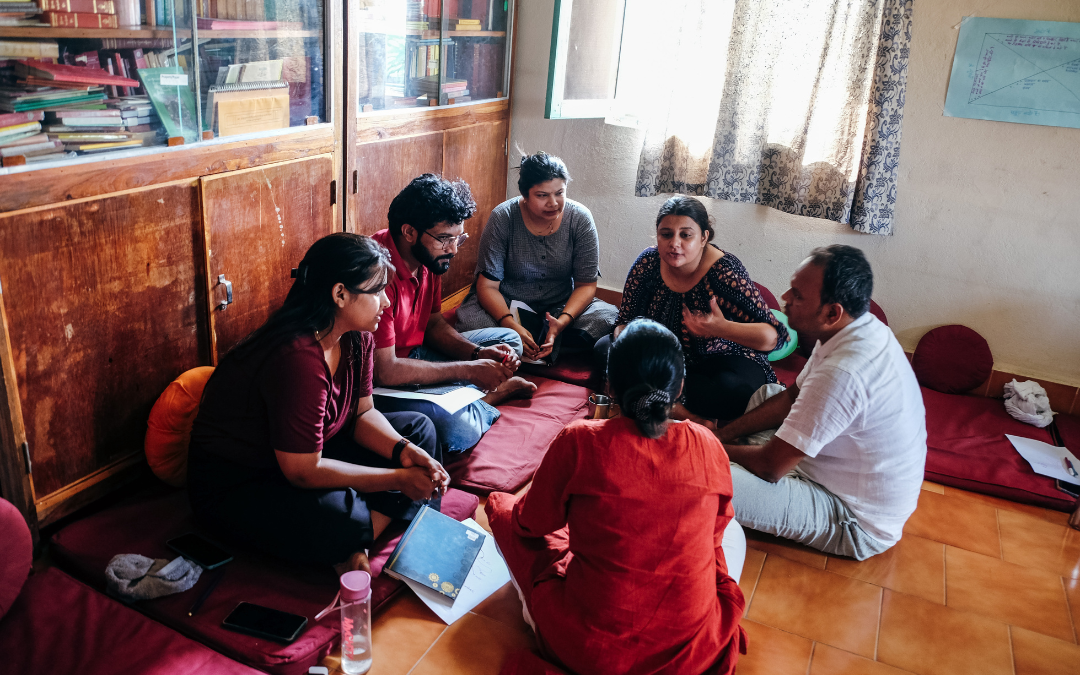
From our first pilot in 2018, we recognized that changing the story of mental health required creating a shared vision of flourishing, building a coalition of advocates, and partnering in practice and not just in name. We’ve come to call this “radical collaboration”: a commitment to center others, set aside recognition, and embrace sacrifice as often necessary for our shared flourishing.
Moving forward, we’re centering our efforts on ensuring that every child can learn mental health skills from their teacher. This evolution in strategy is a continuation of the values that have driven us from the beginning: learning from proximity, interdependency, and mutual compassion. Everything we have learned about co-design, about working through trusted local organizations, about the insufficiency of awareness and treatment alone at population scale— all of it was built across those earlier years of broader work, and all of it is carried forward.
What has changed is where we are choosing to invest our deepest efforts. We have done the work across many contexts. We have seen where change is most meaningful and most lasting. And we are choosing to focus there more deliberately, because we believe that classrooms of all kinds can offer one of the strongest pathways to a future in which mental health is recognized early, supported consistently, and woven into the fabric of community life. Wherever a teacher walks into a classroom, we want to show up in solidarity.
This sharper focus is not about doing less. It is about going deeper where we believe Brio, and the extraordinary partners we work alongside, can have the strongest and most enduring effect.